TVOD, SVOD or AVOD: How to choose the right video revenue model?
In your search for viable revenue models for online video content you have undoubtedly come across the terms TVOD, SVOD and AVOD — transactional-based video on demand, subscription video on demand, and advertising-based video on demand. In this article we dig deeper into these three models and show how to monetize your valuable training, entertainment or educational video content.
Consumers get their video content when they want it, not when a content owner decides to deliver it. The term used to describe this is ‘video on demand’ (VOD). Today, this form of video streaming has surpassed cable subscriptions worldwide — and keeps growing. In our OTT TV guide we explain the landscape where AVOD, SVOD and TVOD operate.
Let’s talk about video business models!
What video streaming business models are there?
The rise of OTT is changing how video is sold, produced, and consumed. Under the hood, different revenue models control access to on-demand video. Broadly, you can choose from three:
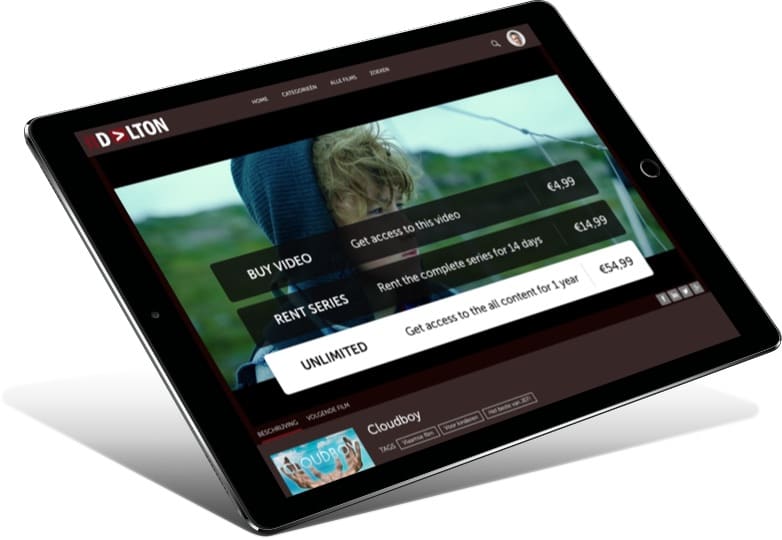
- TVOD – transactional video on demand. Viewers pay a one-time fee to watch, download or rent individual titles.
- SVOD – subscription video on demand. A recurring fee for unlimited access to a catalog (think Netflix, Apple TV).
- AVOD – advertising-based video on demand. Content is free to viewers; revenue comes from ads (e.g., YouTube’s model).
You can also combine models (e.g., pay-per-view plus subscriptions). Below we explore each one in detail.
TVOD – transactional video on demand
TVOD stands for Transactional Video on Demand. Viewers pay for each video they want to watch (pay-per-view). Familiar examples include Apple’s iTunes and Google Play.
For consumers, TVOD offers precise choice without a monthly commitment. Two common TVOD variants are:
- Download To Rent (DTR): the video is available for a limited period (e.g., 48 hours).
- Electronic Sell-Through (EST): you purchase the video for unlimited playback.
Many TVOD providers focus on sports and premium, time-sensitive releases, pairing fresh content with high-quality streaming.
TVOD benefits — when to choose TVOD?
- Price per title lets you deliver clear value and segment premium content.
- Ideal when selling or renting one video or a defined bundle (e.g., a course).
- Works well with a niche catalog; lower commitment can widen your audience.
- Flexible pricing and availability windows (limited-time rentals vs. keep forever).
SVOD – subscription video on demand
SVOD allows users to consume as much premium content as they want for a flat monthly (or annual) fee. Research indicates strong growth in SVOD subscriptions and multi-service households.
Well-known services include Netflix, Apple TV and HBO Max. Because viewers pay for access rather than individual items, they can watch titles an unlimited number of times.
SVOD makes opting out easy, so providers must retain subscribers with exclusive content, smart pricing and ongoing value.
SVOD benefits — when to choose SVOD?
- Best for recurring revenue and sustainable unit economics.
- Great for building a community around exclusive, regularly updated content.
- Friction-light for viewers: broad catalogs, on-demand control, binge-friendly.
AVOD – advertising-based video on demand
AVOD offers content for free while showing ads at set moments (pre-, mid-, or post-roll). A portion of ad revenue goes to the content owner. AVOD is attractive when you can drive large view volumes with content that appeals to a wide audience. The largest AVOD platform is YouTube, but many publishers and broadcasters run AVOD as well. AVOD viewers now make up more than half of digital video viewers.
Premium libraries often avoid pure AVOD because CPMs can yield lower revenue than SVOD/TVOD — but it’s powerful for reach and top-of-funnel.
AVOD benefits — why choose advertising?
- Zero paywall lowers the barrier to attract and hook new viewers.
- Digital ad stacks enable better targeting/personalization than linear TV.
Combining video business models
The beauty of TVOD, SVOD and AVOD is that you can mix and match to fit your goals. A hybrid approach is common as services scale and seek both reach and revenue.
Amazon Prime is a classic SVOD + TVOD example: a monthly subscription includes a catalog, while recent titles are available to rent or buy.
Hybrid model benefits
- SVOD + TVOD: stable recurring income plus high-margin new releases; capture both long-term members and one-off buyers.
- AVOD + (S)VOD: “try before you buy” — build awareness with free, ad-supported content and convert to paid for premium/early access.
OTT platforms offer a business opportunity worth pursuing
In short, video streaming remains a strong opportunity — and it’s not too late to start. Demand is rising, and multi-subscription households mean new entrants can still win audience share.
Enterprises can develop their own VOD delivery using professional video platforms. To build a profitable OTT service, choose between SVOD, TVOD, or a hybrid; add AVOD if reach and top-funnel monetization matter.
VIXY provides a cloud platform for managing and distributing large volumes of video content, supporting SVOD, TVOD and AVOD. Want to explore what fits your strategy?